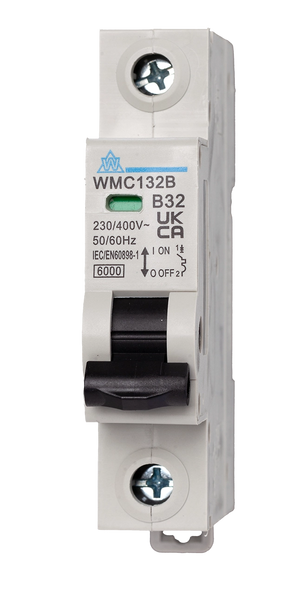


6kA MCB – 25A 1 Pole B Curve (WMC125B)
The WMC125B is a 25A single-pole 6 kA Miniature Circuit Breaker (MCB) engineered for high-load domestic and light-commercial circuits such as cookers, immersion heaters, and fixed plant. It features a B-curve tripping characteristic that operates at 3–5 × rated current to deliver precise overcurrent and short-circuit protection without nuisance tripping....
Read full descriptionThe WMC125B is a 25A single-pole 6 kA Miniature Circuit Breaker (MCB) engineered for high-load domestic and light-commercial circuits such as cookers, immersion heaters, and fixed plant. It features a B-curve tripping characteristic that operates at 3–5 × rated current to deliver precise overcurrent and short-circuit protection without nuisance tripping.
Manufactured to BS EN 60898, the WMC125B fits Whitecliffe consumer units and all standard DIN-rail enclosures. It provides 6 kA fault capacity at 230/400 V AC and a tested mechanical life of 20 000 operations for reliable performance over years of use.
Installer Tip: Ideal for fixed-load circuits such as cookers, immersion heaters or garage feeds. Verify that cable sizing and Zs values remain within BS 7671 disconnection limits for a 32 A B-curve device.
- 25 A rated current with B-curve (3–5 × In) tripping profile
- 6 kA breaking capacity at 230/400 V AC
- Single-pole design – 18 mm module width
- DIN-rail mounted for consumer units and distribution boards
- Complies with BS EN 60898 and BS 7671 (18th Edition A2)
- Service life tested: 20 000 mechanical / 8 000 electrical operations
- Contact-position indicator for easy visual status check
| Part Code | Rating | Curve | Typical Use |
|---|---|---|---|
| WMC120B | 20 A | B | Radial socket and feed circuits |
| WMC132B | 32 A | B | Cookers, heaters and fixed equipment |
| WMC140B | 40 A | B | Sub-mains or high-current loads |
| WMC132C | 32 A | C | Motors or compressors with higher inrush current |
The WMC125B delivers dependable 6 kA protection for heavier domestic and light-commercial loads. For circuits with motors or transformer inrush, see our C Curve MCB range or use Type A RCBOs to add earth-fault protection.
When should I use a C Curve 20 A MCB?
Use on circuits feeding motors, pumps or EV chargers where start-up currents exceed the B-curve limit (5–10 × In tolerance).
Is the WMC120C compatible with Whitecliffe boards?
Yes – it fits all Whitecliffe consumer units and standard 18 mm DIN-rail enclosures.
Can this breaker protect an EV circuit?
Yes – the C-curve profile makes it suitable for most single-phase EV feed circuits. Always follow BS 7671 and manufacturer guidance.
What does 6 kA mean?
6 kA is the maximum fault current the MCB can interrupt safely. For higher fault-level sites, see our 10 kA range.
Do you stock D Curve versions?
Yes – Type D (10–20 × In) MCBs for industrial inrush loads are available on request. Contact our sales team for details.
- Part Code: WMC120C
- Type: Single Pole MCB
- Rated Current (In): 20 A
- Curve: C (5–10 × In tripping characteristic)
- Rated Voltage (Ue): 230/400 V AC
- Rated Frequency: 50/60 Hz
- Breaking Capacity (Icn): 6 kA
- Insulation Voltage (Ui): 500 V
- Impulse Withstand (Uimp): 4 kV
- Dielectric Test Voltage: 2 kV for 1 minute
- Thermal Reference Temp: 30 °C
- Operating Temperature: –5 °C to +40 °C (avg < 35 °C)
- Mechanical Life: 20 000 operations
- Electrical Life: 8 000 operations
- Mounting: 35 mm DIN rail (1 module width)
- Standards: BS EN 60898; BS 7671:2018 (Amendment 2)
- Typical Applications: Radials with motors, EV chargers or transformers requiring inrush tolerance
Install the WMC120C in a suitable consumer unit or distribution board by a qualified electrician. Match rating and curve to the circuit design and expected load profile.
- Mount securely on 35 mm DIN rail with correct busbar alignment
- Use C-curve for EV chargers, motors or transformer-based loads
- Confirm Zs and voltage drop comply with BS 7671
- Tighten terminals to manufacturer torque values and record EIC results