
MCBs – Miniature Circuit Breakers for Domestic & Commercial Circuits
MCBs (miniature circuit breakers) protect electrical circuits against overload and short circuit faults. They are used in consumer units, distribution boards, and three-phase installations to disconnect power automatically when current rises beyond a safe level.
This collection includes Type B MCBs for standard circuits, Type C MCBs for circuits with higher inrush current, and selected specialist options for more demanding applications. Whether you’re replacing a single breaker or specifying a full board, this is the main hub for our MCB range.
Quick answer: An MCB is a resettable circuit breaker that protects wiring and connected equipment from overload and short circuit faults. The right MCB depends on the circuit rating, fault level, and whether you need a B curve, C curve, or more specialist trip characteristic.
Read more
MCBs are one of the most common circuit protection devices used in UK electrical installations. They are fitted across consumer units, three-phase boards, and enclosure-based builds to provide fast disconnection under fault conditions while remaining easy to reset once the issue is resolved.
- Type B MCBs – commonly used on standard domestic circuits such as lighting and sockets
- Type C MCBs – suited to circuits with higher start-up or inrush current
- Selected D curve options – for more specialist high-inrush applications
- Multiple ratings and pole formats – for domestic, commercial, and three-phase use
- 6kA and 10kA options – depending on installation requirements
Need earth leakage protection as well? Browse our RCBO range. For delivery and returns, see our delivery information and returns policy.
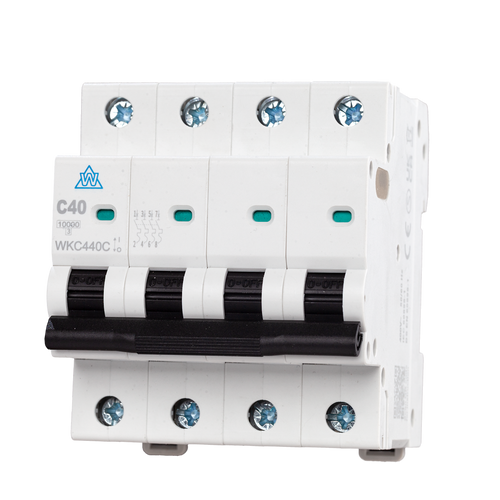
50A 4 Pole 10kA MCB B Curve – WKC450B
£15.05
The WKC450B is a 50A 4 pole 10kA Miniature Circuit Breaker (MCB) designed for three-phase + neutral systems. With a B Curve trip characteristic, it is intended for resistive load applications such as socket outlet groups, small power distribution boards, and general lighting circuits in...
40A 4 Pole 10kA MCB B Curve – WKC440B
£15.05
The WKC440B is a 40A 4 pole 10kA Miniature Circuit Breaker (MCB) for three-phase + neutral circuits. With its B Curve trip characteristic, this breaker is intended for resistive load circuits such as socket outlet banks, small distribution boards, and lighting groups in commercial three-phase...
32A 4 Pole 10kA MCB B Curve – WKC432B
£15.05
The WKC432B is a 32A 4 pole 10kA Miniature Circuit Breaker (MCB) for three-phase + neutral protection. With its B Curve trip profile, this breaker is suited for resistive load circuits such as general socket banks, lighting, and small sub-distribution panels across commercial three-phase boards,...
25A 4 Pole 10kA MCB B Curve – WKC425B
£15.05
The WKC425B is a 25A 4 pole 10kA Miniature Circuit Breaker (MCB) designed for three-phase + neutral circuits. With a B Curve trip profile, it is best used for resistive loads such as lighting banks, socket circuits, and small distribution panels in commercial three-phase boards,...
20A 4 Pole 10kA MCB B Curve – WKC420B
£14.16
The WKC420B is a 20A 4 pole 10kA Miniature Circuit Breaker (MCB) designed for three-phase + neutral protection. With its B Curve trip characteristic, it is best suited for resistive loads such as small power circuits, lighting systems, and distribution boards in three-phase networks, EV...
What Is an MCB?
An MCB, or miniature circuit breaker, is a protective device that disconnects a circuit automatically if it detects an overload or short circuit. Unlike a fuse, an MCB can usually be reset once the fault has been identified and cleared.
What Do MCBs Protect Against?
MCBs are designed to protect wiring and connected circuits against:
- Overload current – where a circuit is drawing more current than it was designed to carry
- Short circuit faults – where fault current rises sharply and rapid disconnection is needed
Types of MCBs
- Type B MCBs – trip faster and are commonly used on standard domestic circuits. Browse B Curve MCBs.
- Type C MCBs – used where circuits have higher inrush current, such as certain motors or commercial loads. Browse C Curve MCBs.
- Type D MCBs – selected for more specialist applications with very high inrush current.
B Curve vs C Curve MCBs
One of the most common selection questions is whether to use a Type B or Type C MCB. In simple terms, B curve is typically used on standard low-inrush circuits such as lighting and sockets, while C curve is used where connected equipment has a higher start-up current. The correct choice depends on the circuit design and the characteristics of the load.
MCB Sizes & Ratings
MCBs are available in a wide range of current ratings. Common UK sizes include:
- 6A and 10A – often used for lighting circuits
- 16A and 20A – common on radial circuits and dedicated loads
- 32A – often used for ring circuits or heavier standard circuits
- Higher ratings – used on larger or more specialised installations
Single Pole, Double Pole & Three-Phase MCBs
The right MCB is not just about amp rating. Installers also need to choose the correct pole configuration for the board and application. Single-pole devices are common in standard domestic circuits, while other formats are used where different isolation or three-phase arrangements are required.
Where MCBs Are Used
- Domestic consumer units – for lighting, sockets, cookers, and other final circuits
- Commercial distribution boards – where different curve types may be needed
- Three-phase installations – where multi-pole devices are used across larger power systems
- Garage, workshop, and outbuilding boards – where dedicated circuit protection is required
MCBs vs RCBOs
An MCB protects against overload and short circuit faults. An RCBO adds residual current protection as well, combining MCB and RCD functions in one device. If the circuit design requires earth leakage protection at circuit level, an RCBO may be the more suitable option.
FAQs on MCBs
What is an MCB used for?
An MCB is used to protect electrical circuits from overload and short circuit faults by disconnecting power automatically when unsafe current levels are detected.
What size MCB do I need?
The correct size depends on the circuit design, cable size, installation method, and expected load. The breaker must be selected to suit the circuit it is protecting.
What’s the difference between Type B and Type C MCBs?
Type B MCBs trip faster and are generally used on standard low-inrush circuits, while Type C MCBs are used where a circuit has a higher start-up current.
Do MCBs need replacing after they trip?
Usually no. One of the main benefits of an MCB is that it can generally be reset once the fault has been found and corrected.
Why Buy MCBs from Power & Data UK?
Power & Data UK supplies trade-focused circuit protection products with dependable UK stock, practical product choice, and fast dispatch. Orders over £30 qualify for free UK mainland next-day delivery, and products are backed by a 2-year manufacturer warranty. For unwanted items, see our returns policy.