
B Curve MCBs for Standard Circuits & Fast Fault Protection
B Curve MCBs are miniature circuit breakers designed for circuits with low inrush current and predictable load behaviour. They are widely used on lighting, socket, and other standard final circuits where fast overcurrent protection is needed without accommodating heavy start-up surges.
Often referred to as Type B MCBs or B curve circuit breakers, these devices are the go-to choice for many domestic and light commercial board layouts.
Quick answer: A B curve MCB typically trips at around 3 to 5 times its rated current, making it suitable for standard circuits such as lighting, sockets, and resistive loads where start-up current is relatively low.
Read more
B curve devices are chosen where the connected load does not create large inrush currents during normal operation. That makes them a strong fit for many everyday installations, especially in homes, smaller commercial units, and consumer unit upgrades where the correct tripping characteristic matters.
- B curve tripping characteristic – trips at around 3 to 5 times rated current
- Ideal for standard circuits – lighting, sockets, and general-purpose final circuits
- Available in multiple current ratings – including common domestic sizes such as B6, B10, B16, B20 and B32
- 6kA and 10kA options – choose to suit the installation fault level
- DIN-rail format – practical for consumer units and distribution boards
Need a different tripping characteristic? Browse our C Curve MCBs, wider MCB range, or full circuit protection collection. For delivery and returns, see our delivery information and returns policy.
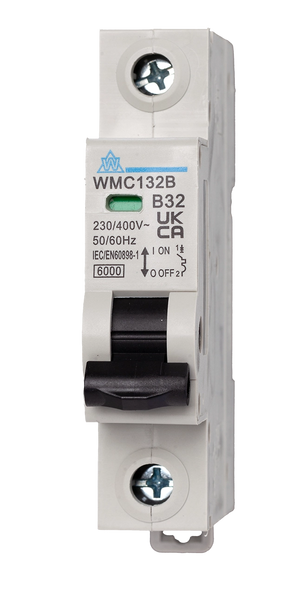
6kA MCB – 6A 1 Pole B Curve (WMC106B)
£1.84
£2.99
The WMC106B is a 6A single-pole 6kA Miniature Circuit Breaker (MCB) designed to provide reliable overcurrent and short-circuit protection on domestic and light-commercial lighting circuits. Rated for 230/400 V AC operation, it features a B-curve tripping characteristic that reacts at 3–5 × rated current -...
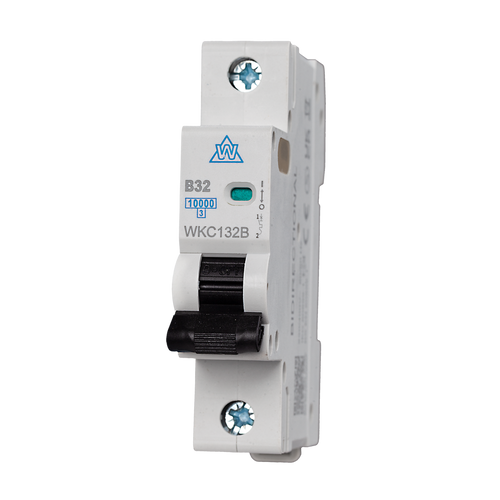
1 Pole 10kA MCB 6A B Curve WKC106B
£5.00
The WCED WKC Series 10kA Miniature Circuit Breakers (MCBs) are high-performance devices designed for precise overcurrent detection and short-circuit protection. Built to handle demanding applications, they provide reliable protection for domestic, commercial, and industrial distribution systems – including solar PV with SPD and EV charging...
6kA MCB – 32A 1 Pole B Curve (WMC132B)
£1.84
£2.99
The WMC132B is a 32 A single-pole 6 kA Miniature Circuit Breaker (MCB) engineered for high-load domestic and light-commercial circuits such as cookers, immersion heaters, and fixed plant. It features a B-curve tripping characteristic that operates at 3–5 × rated current to deliver precise overcurrent...

80A B Curve 2 Pole Twin Screw Terminal MCB (WKT280B)
£12.15
The WKT280B is an 80A B Curve 2 Pole twin screw terminal MCB designed specifically for use with meter isolation and enclosure setups, particularly the WEC enclosure range. It combines a high 80A rating with secure twin screw terminal connections, making it a solid choice...
6kA MCB – 20A 1 Pole B Curve (WMC120B)
£1.84
£2.99
The WMC120B is a robust 20 A single-pole 6 kA Miniature Circuit Breaker (MCB) providing accurate overcurrent and short-circuit protection for socket and radial circuits in homes, garages and light-commercial buildings. It features a B-curve tripping profile that operates at 3–5 × rated current to...
What Is a B Curve MCB?
A B curve MCB is a miniature circuit breaker designed to trip when current reaches approximately 3 to 5 times the device’s rated current. This tripping profile makes it suitable for circuits where start-up current is low and a sudden spike is more likely to indicate a genuine fault condition.
Where B Curve MCBs Are Commonly Used
- Lighting circuits – including many domestic and general-purpose lighting runs
- Socket circuits – where connected loads are generally predictable
- Resistive loads – such as immersion heaters and similar equipment
- Standard domestic consumer units – where low inrush characteristics make B curve the right fit
- Light commercial circuits – where circuit behaviour remains within standard operating patterns
B Curve vs C Curve MCBs
The main difference between B curve and C curve MCBs is how much current they tolerate before magnetic trip operation occurs. A B curve MCB trips faster, which makes it better suited to standard low-inrush circuits. A C curve MCB is usually selected where equipment has a higher start-up current, such as certain motors, compressors, or inductive loads.
- B curve – typically used on standard circuits with lower inrush current
- C curve – better suited to circuits with higher inrush or start-up surges
What Does “B6” Mean?
A device marked B6 is a B curve MCB rated at 6A. In the same way, B10, B16, B20 and B32 indicate both the tripping characteristic and the current rating of the breaker.
Breaking Capacity & Selection
B curve MCBs are available in different breaking capacities, commonly 6kA and 10kA. The correct choice depends on the design of the installation and the prospective fault current at the point where the device is fitted. The current rating must also be selected to match the cable size, installation method, and intended load.
Typical Ratings for Standard Circuits
Common choices include 6A and 10A for lighting, 16A or 20A for radial circuits, and 32A for ring circuits or heavier standard loads, depending on the design requirements of the circuit.
FAQs on B Curve MCBs
What is a B curve MCB used for?
A B curve MCB is used on circuits with low inrush current, such as lighting, sockets, and many standard domestic or light commercial final circuits.
What does a Type B circuit breaker mean?
A Type B circuit breaker refers to the device’s tripping characteristic. It is designed to trip at around 3 to 5 times its rated current.
What’s the difference between B curve and C curve?
B curve trips faster and is better for standard circuits. C curve is generally chosen where equipment produces higher start-up or inrush current.
Is a B curve MCB suitable for domestic use?
Yes. B curve MCBs are widely used across domestic consumer units because they match the behaviour of many common household circuits.
Why Buy B Curve MCBs from Power & Data UK?
Power & Data UK supplies trade-focused circuit protection products with dependable UK stock, practical product choice, and fast dispatch. Orders over £30 qualify for free UK mainland next-day delivery, and products are backed by a 2-year manufacturer warranty. For unwanted items, see our returns policy.